
Add up the conversions each ad platform claims and you will usually get more conversions than your business recorded. Every platform grades its own influence under its own attribution rules, and none of them can observe the counterfactual: what would have happened if the ad had never run. That counterfactual is the only thing you are actually paying for.
After 22 years in marketing and $8M+ of managed spend, my position on this is boring and firmly held. Attribution is for steering week to week. Incrementality is for deciding what deserves money at all. Confusing the two is the most expensive habit in performance marketing.
The eBay lesson keeps getting relearned
The canonical study is a decade old and still under-read. Economists Blake, Nosko and Tadelis published large-scale field experiments at eBay in Econometrica in 2015. The company halted brand-keyword search ads on some engines and in selected geographies while leaving others running as controls. Nearly all of the forgone paid clicks and their attributed sales came back through organic search. For brand terms, natural search turned out to be close to a perfect substitute for paid. Attribution had been assigning real revenue to ads that mostly intercepted people already on their way.
I ran a scaled-down version of that test on an e-commerce account: brand search paused in a set of matched regions for several weeks, business as usual everywhere else. Total revenue in the holdout regions barely moved and organic clicks absorbed the difference. I moved the brand budget into non-brand Shopping and nobody outside the reporting ever noticed. Not every account gets that result, and defending your brand term against an aggressive competitor bidding on it is a separate question. But “the platform attributed it” was never the evidence it appeared to be.
The error runs in both directions
The tidy story is that platforms always overstate their own value. The evidence is messier. In July 2025, incrementality firm Haus published an analysis of 640 Meta lift experiments, with the average advertiser in the sample spending $14 million a year on the platform. Meta drove roughly 19% average lift to the brands’ primary KPI. And for direct-to-consumer outcomes measured against 7-day click attribution, Meta under-reported its own incremental impact by about 15% on average.
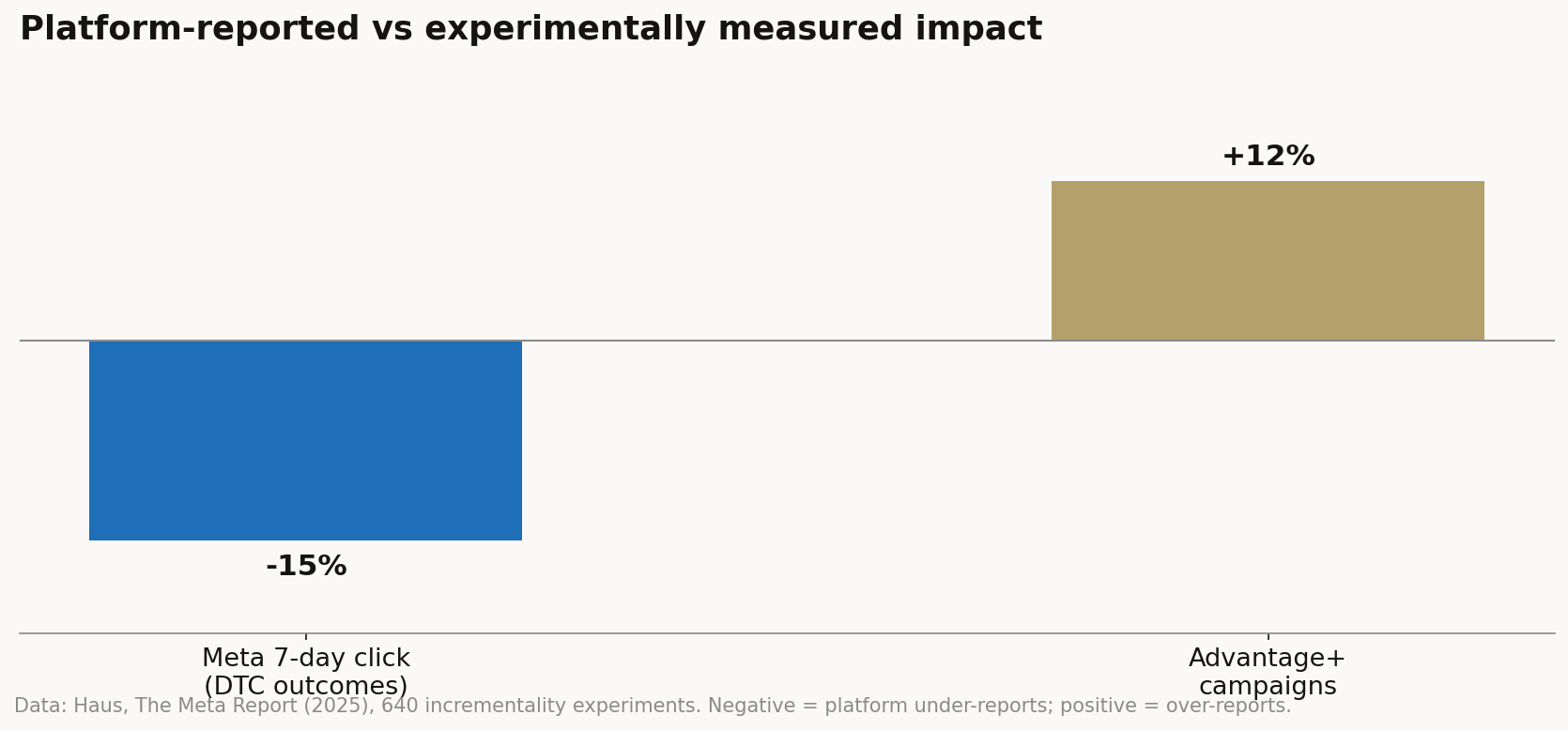
Across 640 lift tests, Haus found Meta’s 7-day click attribution under-reported incremental DTC results by about 15% on average, while Advantage+ campaigns over-reported by 12 percentage points relative to experiments. The direction of the error depends on where you look.
The same report found 58% of brands saw higher incremental ROAS on manual campaigns than on Advantage+. None of this means Meta is secretly great or secretly terrible. It means the gap between attributed and incremental is account-specific and unstable, so the folk remedy of applying one universal discount to platform ROAS is guesswork wearing a lab coat. You have to measure your own gap.
Geo holdouts, and why MMM came back
The cheapest credible incrementality tool for a mid-size advertiser is the geo holdout. Pick matched markets, withhold or boost one channel in the treatment set for four to six weeks, and read the result in backend revenue rather than platform conversions. The platforms now offer packaged versions of this, but you can run one with a spreadsheet and discipline. The eBay team did it more than a decade ago.
Design notes from having run a few: make the holdout large enough to read against normal revenue noise, match markets on trend rather than just size, and agree on the read-out metric before launch so nobody relitigates it once the number is inconvenient. Most failed geo tests fail at the design stage, not the analysis.
Above the experiments sits marketing mix modeling, which has shed its big-CPG-only reputation. Google open-sourced its Meridian MMM in January 2025 after testing with hundreds of brands, alongside a program of more than 20 certified measurement partners. The demand side moved too: a July 2025 TransUnion survey with EMARKETER found 46.9% of US brand and agency marketers planning to invest in MMM within twelve months, and 27.6% now call it the most reliable measurement methodology available to them. Privacy regulation broke user-level tracking slowly enough that the industry circled back to statistics that never needed cookies in the first place.
A triangulation setup that fits a real budget
For an advertiser spending $50K to $200K a month, I structure it in three layers.
- Attribution, daily. Platform-reported and GA4 numbers steer bids, budget shifts between campaigns and creative calls. Fast, granular, directionally useful, never the final word.
- Incrementality tests, quarterly. One geo holdout per quarter on the biggest or most doubted line item: brand search, Performance Max, retargeting, whichever claim smells inflated. Each test yields a channel-specific multiplier between attributed and incremental results.
- MMM, refreshed monthly or quarterly. A lightweight model over two to three years of weekly data guides allocation across channels, calibrated against the experiment multipliers so it is more than correlational curve-fitting.
The layers check each other. When the MMM and platform attribution disagree violently about a channel, that channel gets the next holdout. When a test contradicts the model, the model gets recalibrated. The whole setup costs a fraction of what most teams spend on dashboards, and it is the closest thing to ground truth a mid-size budget can buy.
The map is still worth having. I look at platform ROAS every single morning. I just stopped confusing it with the territory it claims to describe.