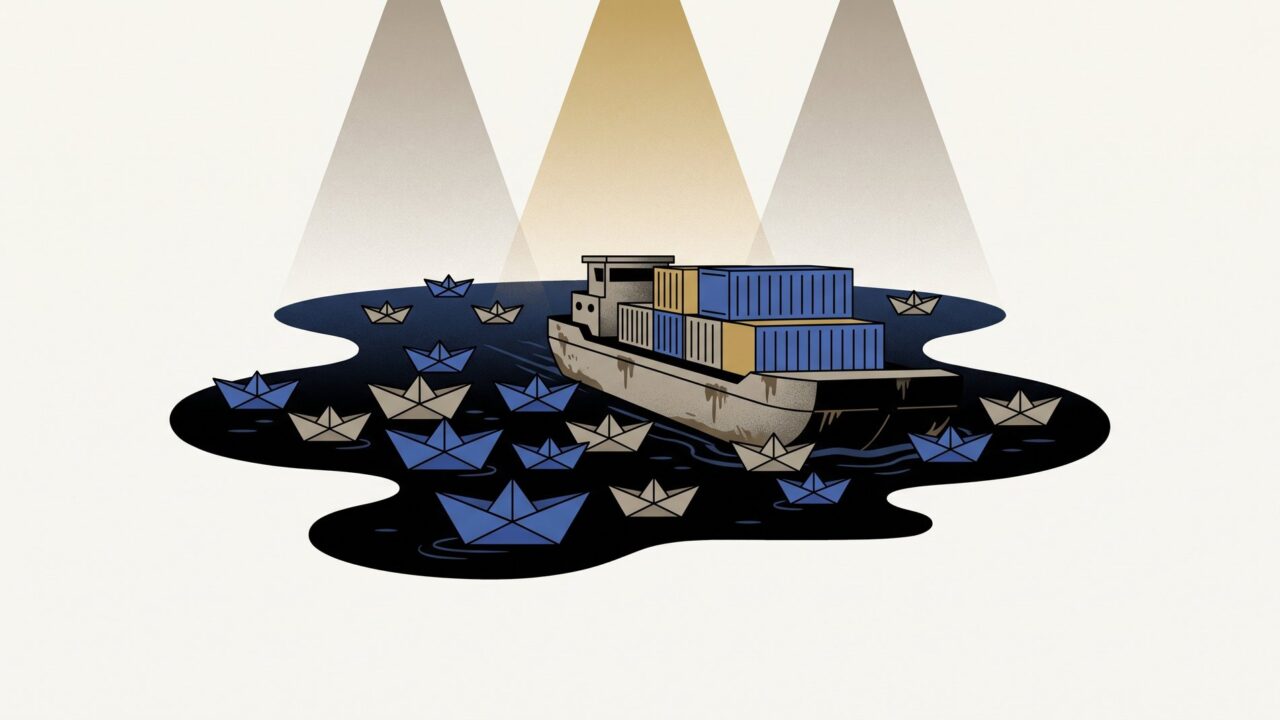
Ninety-five percent of enterprise generative AI pilots produce no measurable P&L impact. That is the central finding of The GenAI Divide: State of AI in Business 2025, the report MIT’s NANDA initiative released last August, built on a review of more than 300 publicly disclosed AI initiatives plus structured interviews and surveys of senior leaders, as covered by Fortune (2025).
The number that makes it hurt is the denominator. Virtualization Review (2025) summarized the same report bluntly.
$30 to $40 billion in enterprise spending on generative AI, and 95% of organizations seeing no business return (MIT NANDA, 2025).
I have run an AI automation practice inside my agency since 2024: agents for lead qualification, research, content production and support, plus back-office RPA. I read the MIT report the week it circulated and did not find one surprising sentence in it. I have watched pilots die up close, including one of my own early ones.
The learning gap is the diagnosis, not the disease
MIT’s explanation for the divide is what the authors call the learning gap. In their words, most GenAI systems “do not retain feedback, adapt to context, or improve over time.” The model answers, the transcript evaporates, and next Monday the system is exactly as useful as it was last Monday.
That framing is accurate and still one level too shallow. A system cannot retain feedback if there is nowhere to retain it. The typical pilot is stateless by construction: a prompt, a model API, a curated demo dataset and a slide deck. There is no record of what the system did yesterday, so there is nothing for it to learn from today, and no place where a human correction gets captured for tomorrow.
The learning gap is a symptom. The disease is that pilots are built as performances rather than as infrastructure.
Demos have an audience; production has an owner
Two years of shipping agents for real workflows has reduced my survival test to three questions.
Does it have state? A demo starts fresh on every run, which is exactly why it looks clean. A production agent has to remember which records it already touched, which runs failed halfway, and what a human corrected last week. That means a database, a work journal and resumable jobs. The moment you add state, the pilot stops being a prompt and starts being software, and most pilot teams were never resourced to build software.
Does it verify its own output? In a demo, the presenter is the verification layer, and the presenter picked the inputs. Unattended, a language model will be confidently wrong on some fraction of runs, and nobody is watching. Every agent I keep in production has a separate verification step that checks the output against a source of truth before anything is written or sent. Generation without verification is how wrong answers ship at machine speed.
Does it have an owner? Not a sponsor. An owner: a person whose actual KPI degrades when the agent silently stops working, and who has the access and authority to fix it that day. Pilots born in innovation teams tend to die in innovation teams, because nobody’s number breaks when they stall.
My own scar is a lead qualification agent. The demo version took a few days and looked spectacular in a screen share. The production version took several times longer, and almost none of that extra time went into prompts. It went into deduplication so a retried run would not contact the same lead twice, the verification pass against the CRM, and an escalation queue for the cases the model was not confident about. None of that demos well. All of it is the reason the thing still runs.
Buying beats building, and the reason is unflattering
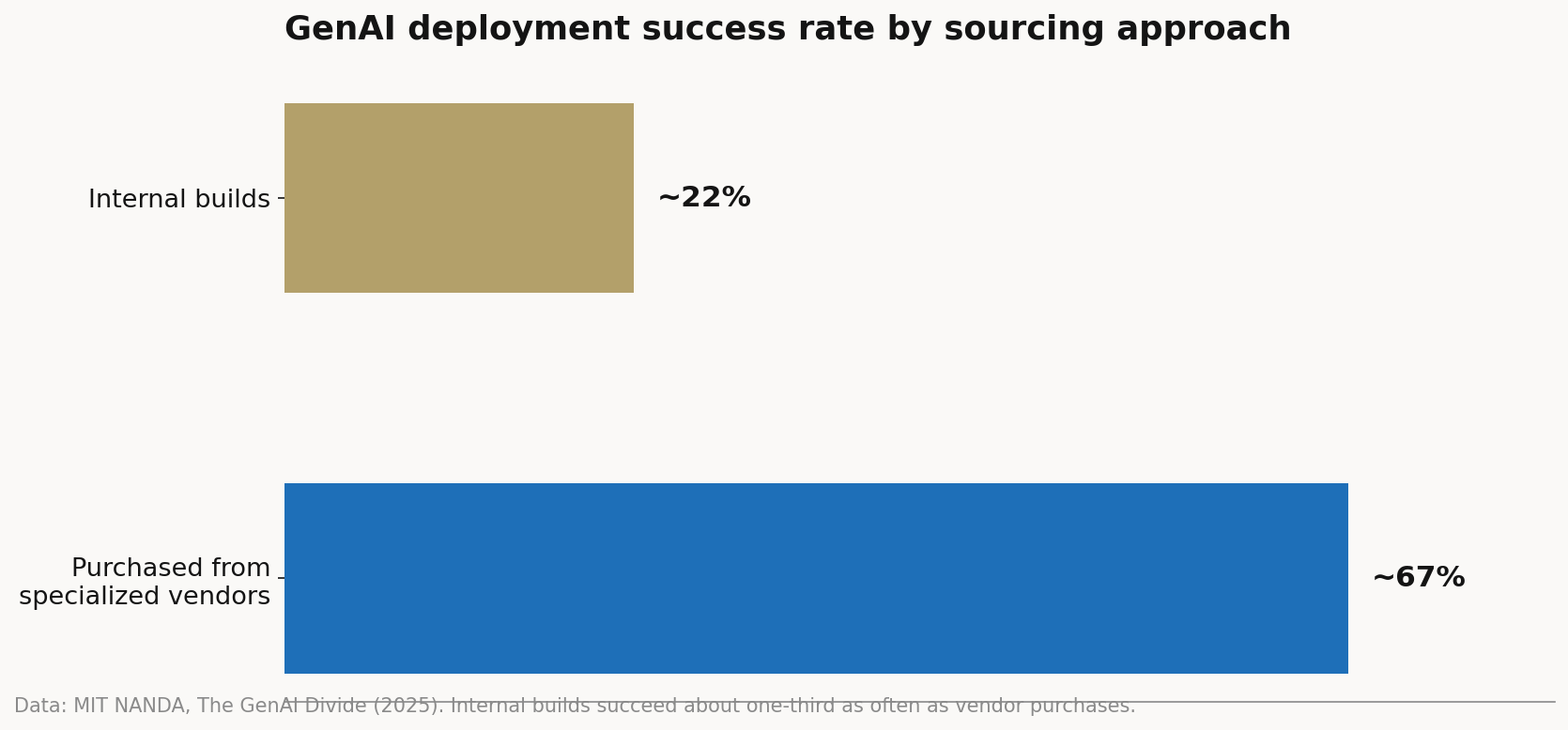
The MIT report’s most practical finding got less attention than its headline: purchasing AI tools from specialized vendors and building partnerships succeeds about 67% of the time, while internal builds succeed only one-third as often, per Fortune (2025).
The wider data points the same direction. In an S&P Global Market Intelligence survey of more than 1,000 organizations across North America and Europe, reported by CIO Dive (2025), the share of companies abandoning most of their AI initiatives jumped to 42%, from 17% the year before. The average organization scrapped 46% of its AI proofs of concept before they reached production.
My read on the buy-versus-build gap is not that vendors have better models. Everyone rents the same models. Vendors win because a product that has survived contact with a hundred paying customers has been forced to become boring infrastructure: it persists state, retries safely, logs everything, and ships with someone contractually on the hook for uptime. An internal pilot is allowed to stop at the applause.
I still build internal agents, for my own operations and for client work, because in narrow marketing workflows the economics justify it. But I build them the way a vendor would be forced to: plumbing first, magic later.
The bar for the 5%
If you are funding a pilot right now, skip the model debate and audit three things instead. Where does its memory live? Who checks its output on the days the demo team is not in the room? Whose KPI breaks when it silently stops?
If the honest answers are nowhere, nobody and no one’s, you do not have a pilot. You have a demo with a burn rate, and the MIT number already tells you how that ends. The 5% that reach P&L impact are not smarter about AI. They are duller about engineering. That is a compliment.