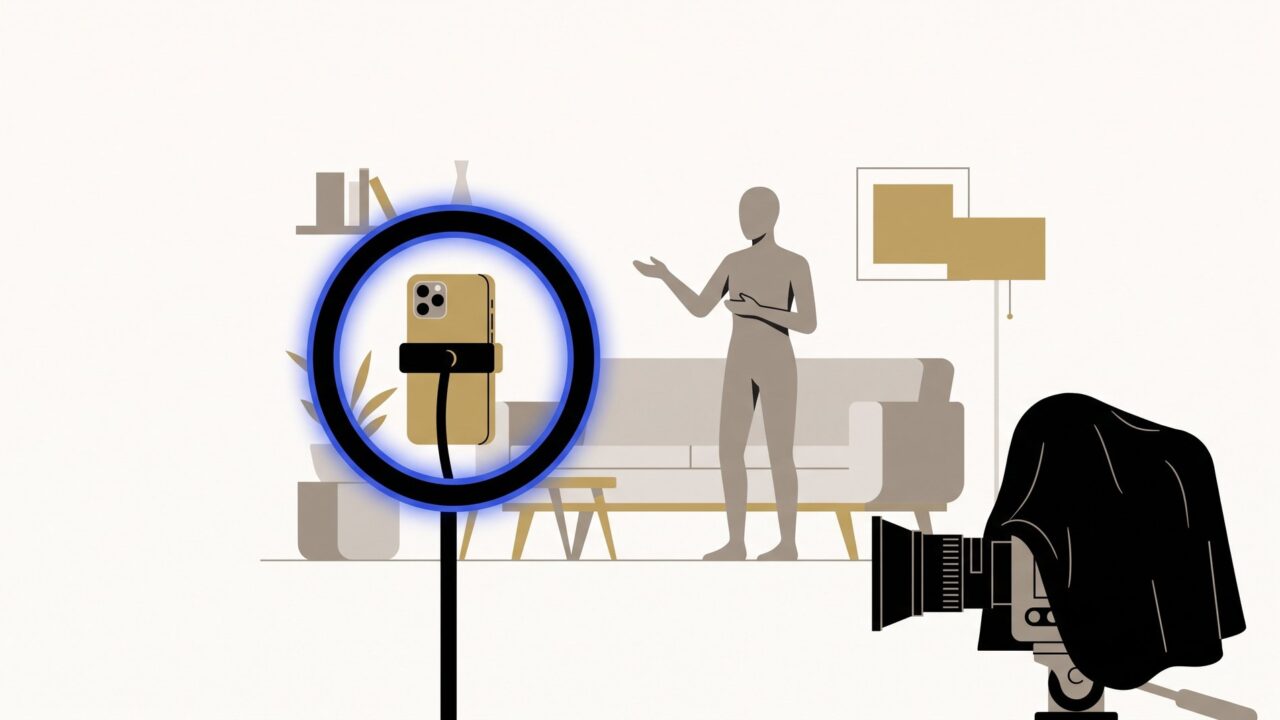
Polish is a performance tax on Meta and TikTok. I keep re-running the same test across client accounts, studio spot against lo-fi creator-style video, and the lo-fi ad keeps winning on CTR and cost per purchase while costing a fraction to produce. At some point you stop calling that an anomaly and start calling it the format.
Consumers have been saying this for years. In Stackla’s 2021 survey of more than 2,000 consumers, only 19% said brand-created content reads as authentic, and just 10% said that about influencer content. Meanwhile, 72% said real customer photos and videos are the content they most want to see, and 80% said they are more likely to buy from an online store that shows photos and videos from real customers.
Why lo-fi wins the auction, not just the scroll
The feed is the context, and the feed is vertical phone footage shot by ordinary people. An ad that resembles the surrounding content earns its first two seconds. An ad that announces itself as an ad gets categorized and skipped before the offer ever loads.
TikTok published its own numbers on this with Spark Ads, the format that runs paid media through a real creator account instead of a brand shell.
TikTok’s testing found Spark Ads deliver a 134% higher completion rate and a 157% higher 6-second view-through rate than standard In-Feed ads.
Those are delivery signals, not vanity metrics. Completion and early view-through feed the ranking systems, so native-looking creative compounds: better watch time buys cheaper distribution, which buys more data, which sharpens optimization. The studio spot loses twice, once with the viewer and again with the algorithm.
To be precise about scope: lo-fi wins in-feed direct response. A luxury brand film, a B2B trust page, a TV cut-down running on YouTube, those live by different rules. But for the ad formats where most e-commerce budgets actually sit, the handheld clip with imperfect lighting is the high performer, and the imperfections are load-bearing. Strip them out and you have rebuilt the studio ad in a phone frame.
Industrializing the format with AI personas
Here is the part I work on daily. Since 2024 my practice has included building AI-generated UGC-style video pipelines: consistent synthetic personas defined by character sheets, scripted against tested hook structures, rendered as handheld selfie-style video, then batch-varied by hook, setting and angle. The scripting runs on open-weight language models on my own hardware, which keeps client product data local and makes the per-script cost effectively zero.
The economics are the point. Sourcing real creators takes weeks per cycle: briefing, shipping product, waiting on takes, chasing usage rights. A synthetic persona is available at midnight, never misses a deadline, holds visual consistency across a hundred videos, and produces the eleventh hook variant at the same cost as the first. Creative refresh, the thing that quietly eats creator budgets, becomes a batch job.
The platforms are not resisting this shift; they are selling it. TikTok launched Symphony Digital Avatars in June 2024, stock and custom AI avatars licensed for branded content. Meta said on its Q1 2026 earnings call that over 8 million advertisers now use at least one of its AI ad creative tools, double the count from the end of 2024. And the IAB’s 2025 video report found 86% of ad buyers using or planning to use generative AI to build video ad creative, with buyers projecting it would reach 40% of all ads by 2026. From where I sit in mid-2026, that projection reads conservative.
One e-commerce client of mine replaced a studio product film with a first batch of AI persona videos while keeping the offer and landing page constant. The batch won on cost per purchase, and it kept winning longer, because hook refreshes were suddenly affordable on a weekly cycle. Directional evidence from one account, but it matches every other time I have run the comparison.
The disclosure section this topic actually deserves
This format works because it borrows the visual grammar of ordinary people. Used lazily, that shades into deception, and I would rather draw the lines explicitly than pretend they do not exist.
Platform policy first. TikTok requires realistic AI-generated content to be labeled and, since May 2024, automatically labels AI content carrying Content Credentials metadata from the C2PA provenance standard. Meta applies AI info labels to detected or self-disclosed AI content and requires advertisers to disclose digitally created or altered political and social issue ads. My pipelines write the AI disclosure flag into the upload step itself, so the label cannot be forgotten under deadline pressure.
Then the line that matters more than any platform rule: a synthetic persona can present, demonstrate and pitch in first person. It cannot claim to be a real customer with a real experience, because a fabricated customer story is a fake testimonial no matter which tool produced it. My scripts position personas as presenters, not as verified buyers. Clients occasionally ask for the fake-review angle. The answer is no, on ethics first and on enforcement risk second.
My experience so far is that honest labeling has not hurt performance in any test I have run. Viewers do not bounce off a label; they bounce off boring. The uncomfortable truth of this category is that authenticity, as the feed defines it, is an aesthetic, and aesthetics can be manufactured. Trust cannot. Spend the production savings on being worth trusting.
Where this lands
Lo-fi creator-style ads are not a bubble trend; they are what the delivery systems reward and what consumers say they prefer. AI personas remove the production bottleneck and turn the format into infrastructure.
The advertisers who will regret this era are not the ones who used synthetic actors. They are the ones who used them to fake social proof instead of using them to ship more honest variations, faster.