
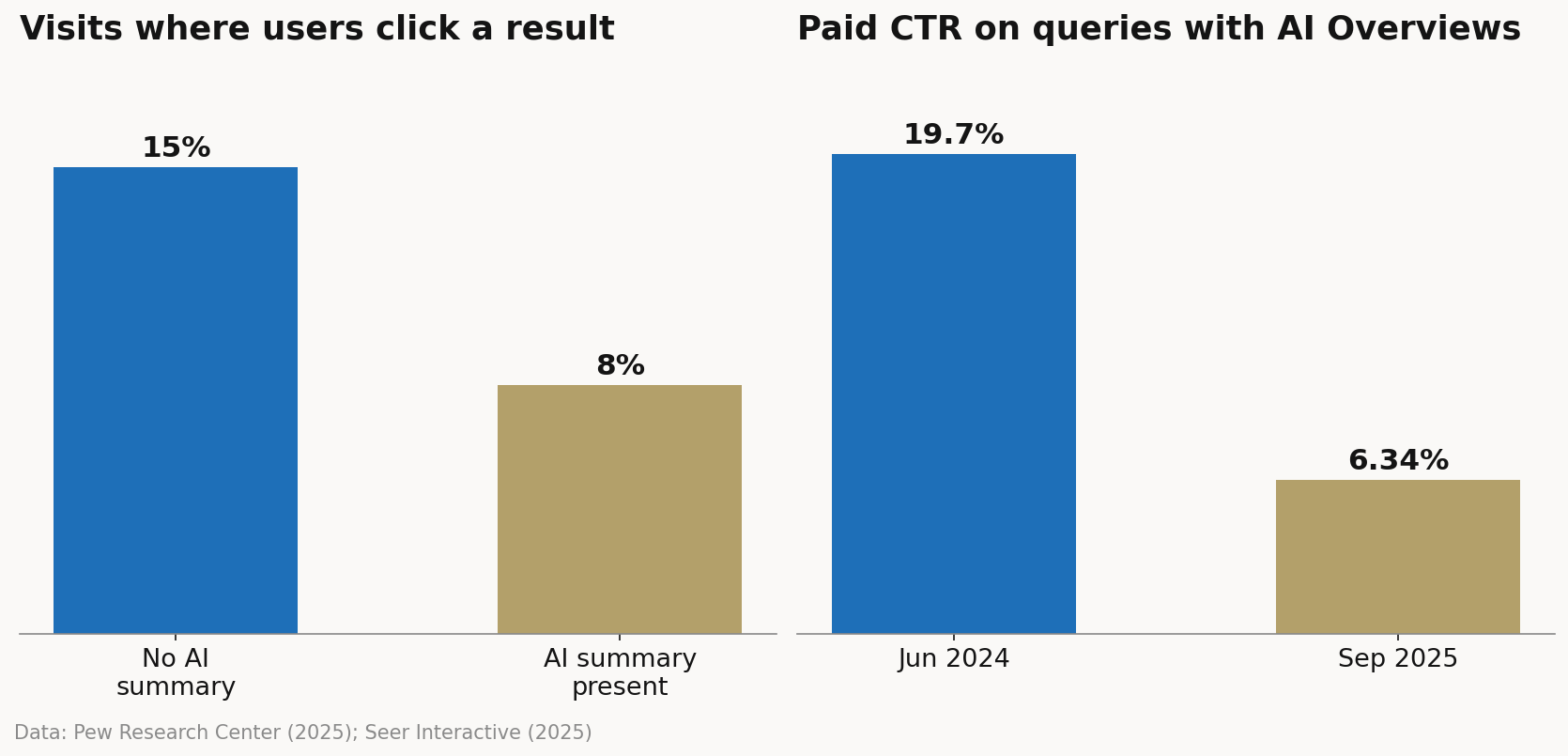
When a Google search shows an AI Overview, people click a traditional result on 8% of visits. When it does not, they click on 15%. Those numbers come from Pew Research Center (2025), which analyzed the real browsing of 900 U.S. adults who agreed to be tracked through March 2025.
I have been buying search traffic for 22 years. The zero-click argument used to run on vendor estimates and conference anecdotes. It now runs on observed behavior, and the observed behavior is worse than the anecdotes were.
What Pew actually observed, and why it is hard to dismiss
The design is what makes this study different. Pew did not survey people about their habits; it monitored 68,879 real Google searches inside real browsers. About 18% of those searches produced an AI summary, and the clicks tell a consistent story.
First, the headline: clicks on traditional results roughly halve when a summary is present, 8% versus 15% of visits. Second, sessions die on the results page more often. Users ended their browsing session entirely on 26% of pages with an AI summary, versus 16% of pages with only classic results. The answer box is not a doorway. It is a destination.
Third, the number I keep repeating to clients:
Users clicked a source link inside the AI summary on just 1% of the visits where a summary appeared.
The citation, the consolation prize publishers were offered, is not a traffic mechanism. Google pushed back, calling the study a flawed methodology on a skewed queryset, as reported by Search Engine Land (2025). Maybe the sample skews informational. But Google kept scaling the feature while arguing about the denominator: by July 2025, Alphabet reported AI Overviews reaching 2 billion monthly users, per TechCrunch (2025). You can argue with Pew’s queryset. You cannot argue with the rollout.
The paid-search numbers nobody puts in the deck
The Pew study is about organic behavior. The half of my job that spends money got its own dataset from Seer Interactive (2025), which tracked 3,119 informational queries across 42 organizations, covering 25.1 million organic and 1.1 million paid impressions from June 2024 through September 2025.
On queries where an AI Overview appeared, organic CTR fell from 1.76% to 0.61%, a 61% decline in fifteen months. Paid CTR on those same queries fell from 19.7% to 6.34%, a 68% decline. Read that again: the ads lost proportionally more than the organic listings did.
Two details in Seer’s data matter more than the headline. One: this is not purely an AI Overview story, because organic CTR on queries without an Overview still fell 41% over the same window. The whole results page is getting less clicky. Two: the exception. Brands cited inside the AI Overview earned 35% higher organic CTR and 91% higher paid CTR than brands that were not cited.
Hold those two findings from Pew and Seer together and they stop contradicting each other. Almost nobody clicks the citation link itself, yet being cited nearly doubles the performance of your paid listing on the same page. The citation is not a traffic source. It is a trust signal that transfers to whatever else of yours the user sees.
What I changed in the accounts I run
Split informational from commercial before judging anything. The collapse concentrates in informational queries, which is exactly where Seer measured. I now segment search terms and Search Console queries by intent before reviewing CTR, because a blended number averages a healthy commercial funnel with a cratering informational one and tells you nothing.
Stop treating rank as a traffic forecast. On a content-heavy e-commerce account I manage, Search Console impressions held steady for three straight quarters while clicks slid month after month. Rankings had not moved. The position was fine; the click simply was not there anymore. Any forecast built on historical position-to-CTR curves is fiction now.
Accept that a scarcer click is a more valuable click. When the results page answers the easy questions itself, the users who still click through self-select for intent. I watch conversion rate and cost per acquisition before touching budgets on the basis of a CTR chart. Cutting spend because CTR fell is how you hand the remaining, better-qualified clicks to a competitor.
Defend brand without apology. Fewer total clicks makes every branded click more contested, and AI surfaces now sit between you and users who had already chosen you. I hold brand coverage even when a finance team asks why anyone should pay for their own name. The answer is on the results page itself, above the first blue link, and it is not always the brand’s answer.
Shift weight toward formats the Overview cannot replace. A summary can answer a question; it cannot ship a product. Shopping placements, remarketing, and bottom-funnel search have held up better in my accounts than informational non-brand ever will again, so that is where reallocated budget goes first.
Work to be the citation. That 91% paid lift is the closest thing to a free multiplier in this dataset. Clean structured data, current product feeds, and pages that answer the question directly are no longer just SEO hygiene. They are paid-search support work.
The click was never the product
The click was always a proxy for attention, and the proxy is breaking faster than most reporting stacks admit. Measurement has to move to outcomes: server-side tracking, first-party conversion data, incrementality tests where the budget supports them.
Organic informational reach is repricing toward zero while paid becomes the reliable way to buy presence on a page that answers first and links second. I do not love that arrangement. I plan for it, because the alternative is reporting last year’s CTR to a client living in this year’s results page.